Resources
Books, modalities, and tools.
This isn't clinical authority. It's a record of what actually worked, one path through trial and considerable error, offered as evidence rather than expertise. Each modality below has a plain definition from an established medical source, and my own account of what it did for me specifically.
Modalities
Speak to a licensed professional before beginning any of these.
EMDR
A structured therapy using bilateral stimulation to help the brain reprocess traumatic memories that have become stuck.
What it did for me: before EMDR, my brain was a 300 square foot studio with a view of a brick wall. Now it's a 30,000 square foot warehouse.
Read the full account
IFS: Internal Family Systems
A therapy model treating the mind as distinct inner parts, guided by a core Self. Designated evidence-based in 2015.
What it did for me: talking never worked, not until I learned to talk to my own Parts instead. Years with a trained IFS therapist, now mostly on my own.
Brainspotting
A brain-body therapy using fixed eye positions to access and process trauma and difficult emotion. Newer than EMDR, smaller research base.
What it did for me: I thought it was bullshit at first. Then I learned it targets the part of your brain holding a thought, not just the thought itself.
Neurofeedback
A form of biofeedback using real-time brain activity readouts, most often EEG, to train self-regulation of brain function.
What it did for me: your brain is your second most valuable resource. Treat it like one and train it. I use the Myndlift app for this at home.
Ketamine-Assisted Therapy
A rapid-acting treatment used in a clinical setting under a trained provider, often when other treatments haven't worked.
What it did for me: this deepens everything Brainspotting already does, quicker, more intense, longer lasting results.
Biofeedback
A technique connecting you to sensors reading your body's involuntary functions so you can learn to influence them directly.
What it did for me: I was terrible at meditation, could never keep up a practice.
Muse trains my brain into the right waves for calm and focus, and having any practice at all is the actual win. Use code
ANECESSARYMURDER for 15% off.
TMS: Transcranial Magnetic Stimulation
An FDA-cleared, non-invasive outpatient treatment using magnetic pulses to treat major depressive disorder and OCD.
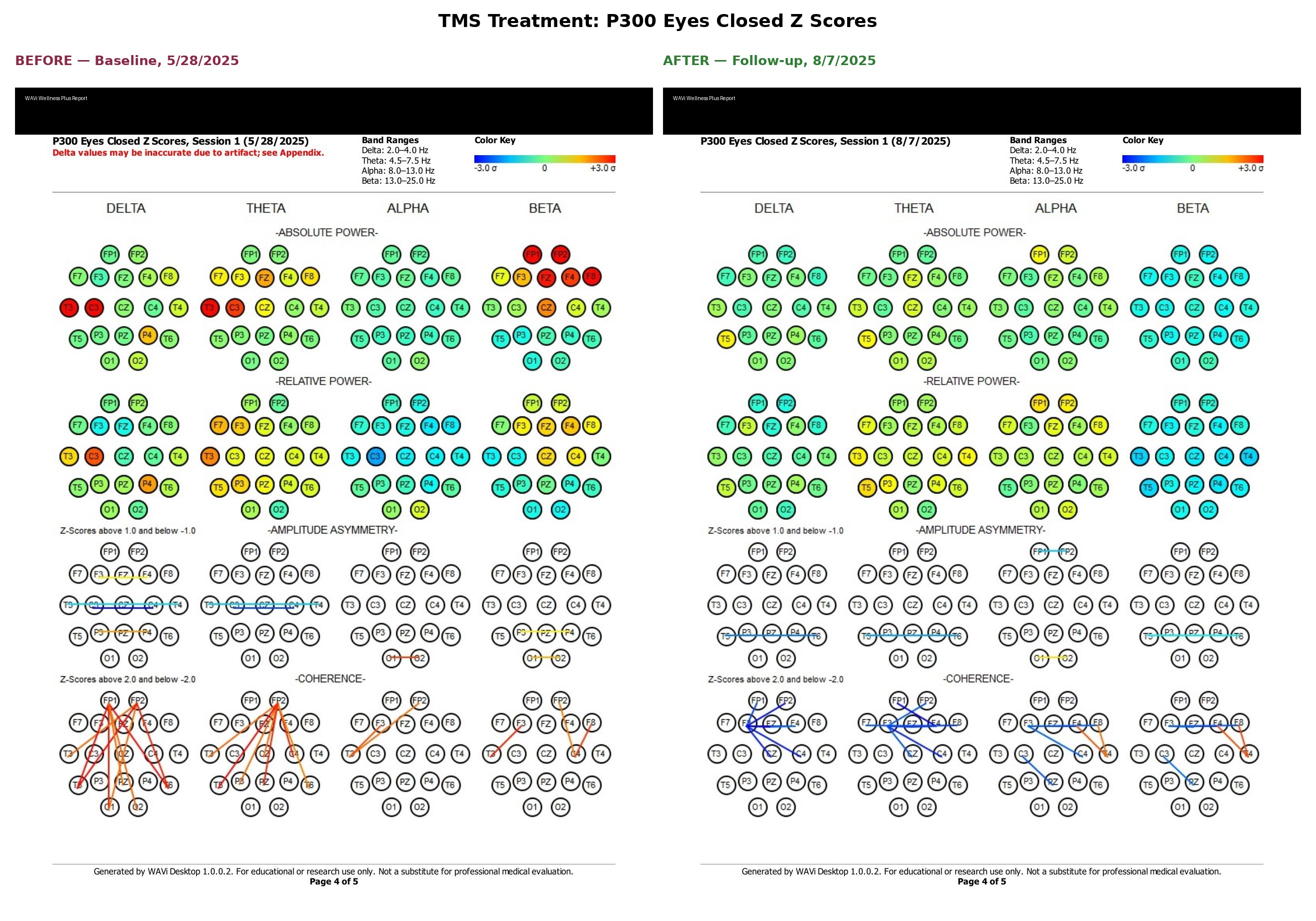
Ten weeks, same electrodes. The scans speak for themselves.
Journaling
The oldest tool on this list and still the first one worth reaching for.
Meditation
Consistency matters more than duration. Five minutes daily outperforms an hour once a week.
Astrology
Used here as a behavioral and psychological framework, not a predictive one. The chart describes a nature, not a fate.
Tarot
Same principle as astrology. A mirror, not a crystal ball.
Medication
Symptom management, not weakness. A conversation to have with a doctor, not a journal entry.
Books
Pete Walker. The number one recommendation here. Start with this one.
Pete Walker. Goes deeper into the emotional landscape of trauma, feeling through it rather than around it.
Richard Schwartz. The foundational IFS text, best paired with a therapist first.
Bessel van der Kolk. Deserves its reputation, unflinching in its content. Read once some foundation is already in place.
Michael A. Singer. On the difference between a thought and the self that's watching it.
Carol S. Dweck. How thinking shapes outcome, held up across an entire book.
Stephen Cope. On dharma, and the grief of not yet becoming who you're meant to be.
Tara Brach. Embracing your life with the heart of a Buddha, when believing something is wrong with you is the deepest suffering there is.
Judith Grisel. A neuroscientist and recovering addict on how drugs actually work on the brain, and what that means for getting free of them.
Dr. Joe Dispenza. Where meditation, epigenetics, and quantum physics meet, for anyone ready to take that seriously.
Dr. Joe Dispenza. How to reprogram the body's automatic thinking, one honest habit at a time.
Meg Josephson. On the fawn response, for anyone who's spent a life reading rooms instead of living in them.
Dr. Nicole LePera. Recognize your patterns, heal from your past, build the self from there.
Todd Herman. On the version of yourself that shows up when the stakes are real, and how to call on her deliberately.
Charles Duhigg. Cue, routine, reward, and why understanding the loop matters more than willpower ever did.
Cal Newport. Focus as a discipline, not a personality trait.
Cal Newport. Choosing a focused life on purpose, instead of drifting into a noisy one.
James Nestor. The science of a lost art, and why how you breathe changes everything else.
Patrick McKeown. Breathing techniques with real research behind them, not just a trend.
Dr. Aditi Nerurkar. A Harvard stress expert's approach to rewiring brain and body for real resilience, not just less stress.
Looking for the products, apps, and supplements I actually use? See The Shop.